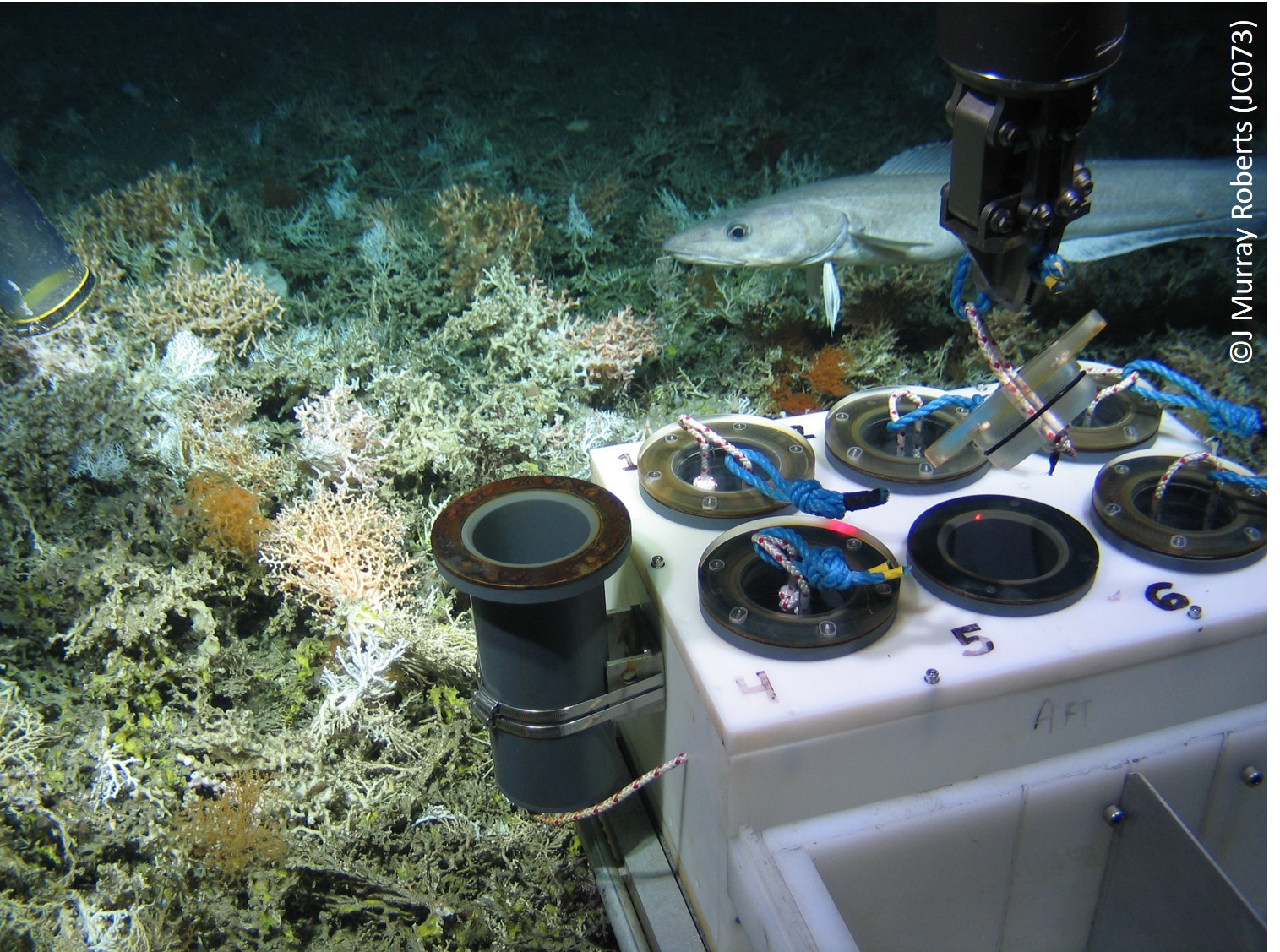
The biomass of the sponge Spongosorites coralliophaga, and the coral Lophelia pertusa were calculated from images that were extracted from remotely operated video footage. Environmental variables derived from acoustic data (depth, BPI, rugosity, backscatter, slope) were used to create a biomass predictive map with a random forest model approach. From this map we could estimate standing stock biomass, the annual carbon turnover and explore the potential food supply to the reef.
The total overturn of organic carbon at the Mingulay reef was estimated with L. pertusa coral rubble and S. coralliophaga being the largest contributors toward carbon turn-over in the area. We also calculated the additional supply of organic matter to the reef through tidal downwelling.
This study is the first to estimate whole-reef cold-water coral biomass and advances our understanding of the complexity (variability and distribution) of community metabolism within the CWC reef. The methodology has the potential to be applied to other under-water habitats and increase understanding of carbon turnover at an ecosystem scale.
Addressing target audiences and expressing needs
- Collaboration
We wish to share our knowledge with others that can benefit from its application in their own work. We are also interested in collaborations focusing on more site-specific respiration rate measurements, machine learning algorithms to automatically measure surface area of coral, sponges and applying this method on other CWC reefs and other ecosystems. From a monitoring perspective, our method offers a low-cost way to estimate loss of biomass & changes in carbon turnover over local and larger spatial scales. The maps & the data generated are easy to interpret & could be used to inform policy.
- Research and Technology Organisations
- Academia/ Universities
Result submitted to Horizon Results Platform by THE UNIVERSITY OF EDINBURGH