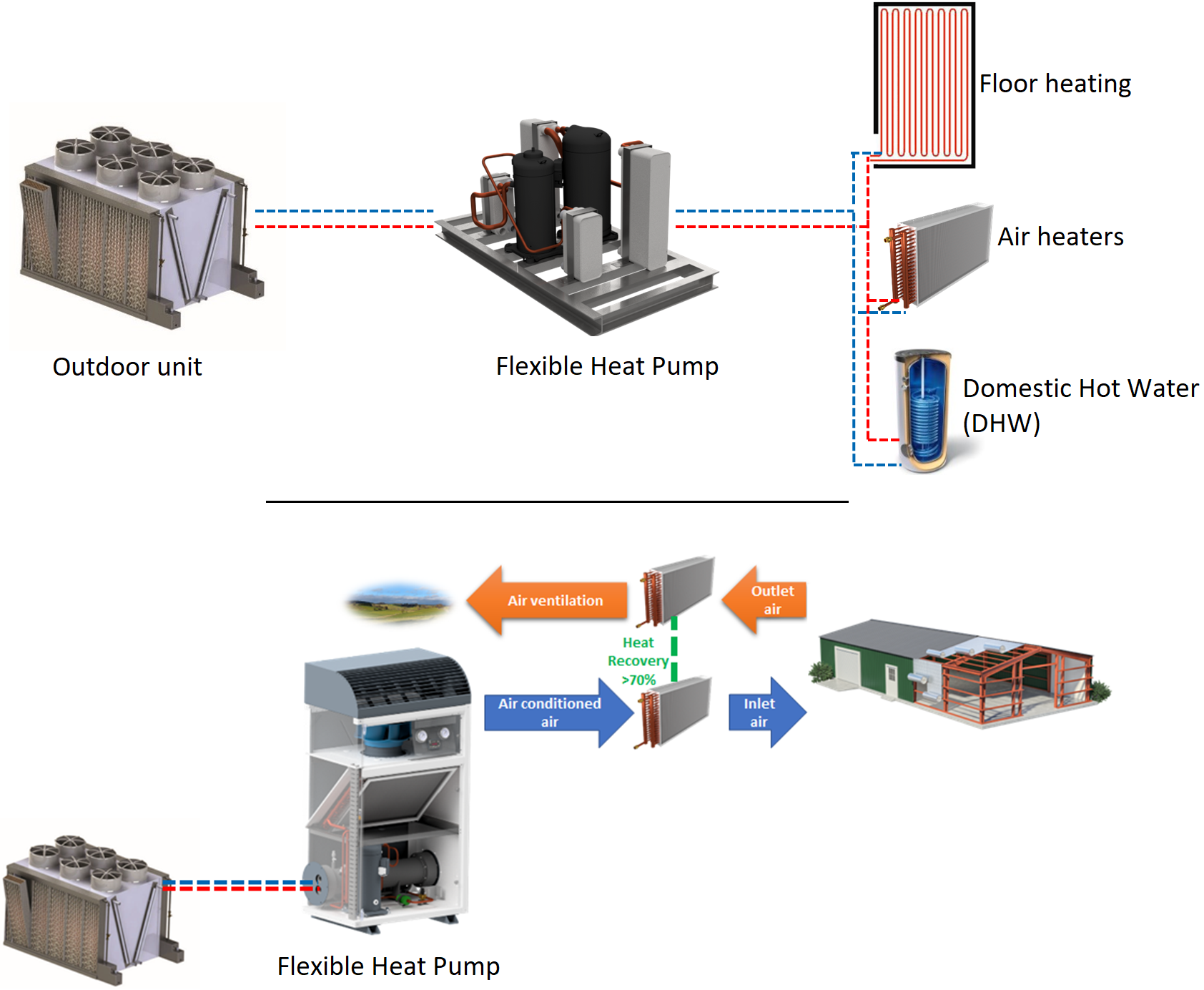
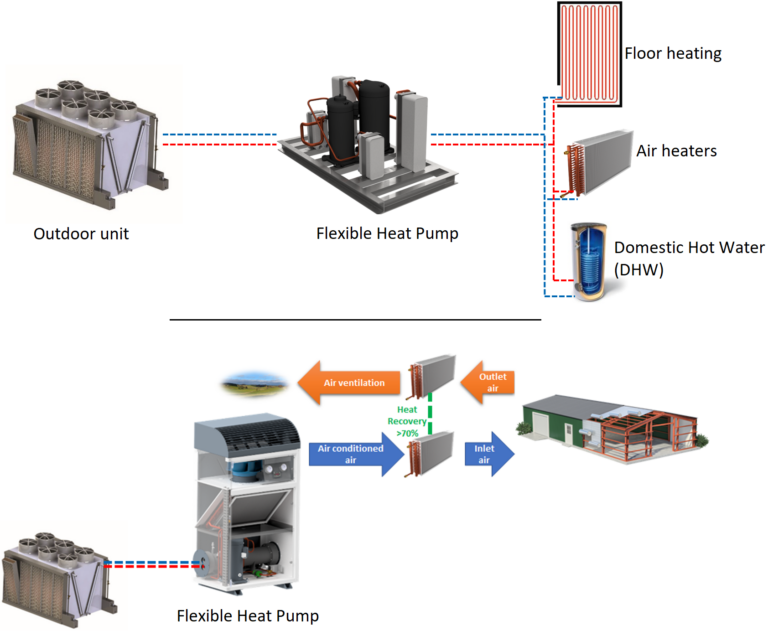
A modular heat pump that can be applied in all livestock buildings has been developed. Its design is based on a flexible modular configuration that can be stacked together to exactly address the needs of different buildings, focusing on cost-effectiveness, low complexity, and low maintenance needs. Practically this is assured by making use of the “modularity” feature. Depending on the case, the thermal load can be covered by adding heat pump units in parallel that are capable to operate in complementary modes (e.g., sensible cooling-dehumidification), so to guarantee optimal indoor conditions. Its design also considers the optional use of other heat sources (e.g., ground heat, solar heat, available thermal storage tanks, etc.).
 Oceans, seas and waters
Addressing target audiences and expressing needs
- Investor introductions
- Business plan development
- Expanding to more markets /finding new customers
Establish a network of businesses, entrepreneurs and investors active in the livestock and agri-food industry, to communicate our products’ features and potential, receive feedback and adapt accordingly, both our products and marketing approaches.
- Public or private funding institutions
- Other Actors who can help us fulfil our market potential
- Private Investors
R&D, Technology and Innovation aspects
At the moment, the first units have already been manufactured and the initial test have been run. The next steps are to install and test them in real conditions in three different livestock facilities to caver their strongly diversified needs.
Replicability is at the core of the modular heat pump we develop. Practically this is assured by making use of the “modularity” feature, constituting the units capable to operate in livestock buildings hosting different animals (pigs, chickens, cows) for different end products (broilers, egg production), and under diverse climatic conditions. The Its design also considers the easy integration of other Renewable Energy Sources (RES) technologies.
With:
(i) the adoption of Renewable Energy Sources (RES) technologies to be here to stay on a global level, and
(ii) livestock buildings in constant need of considerable amounts of energy to secure suitable climatic conditions (in order to ensure optimal growth and animal welfare), while
(iii) energy costs and insecurity rise,
businesses researching, developing, and manufacturing innovative green, sustainable products are going to play an integral part in the energy transition to come.
- Global