Result description
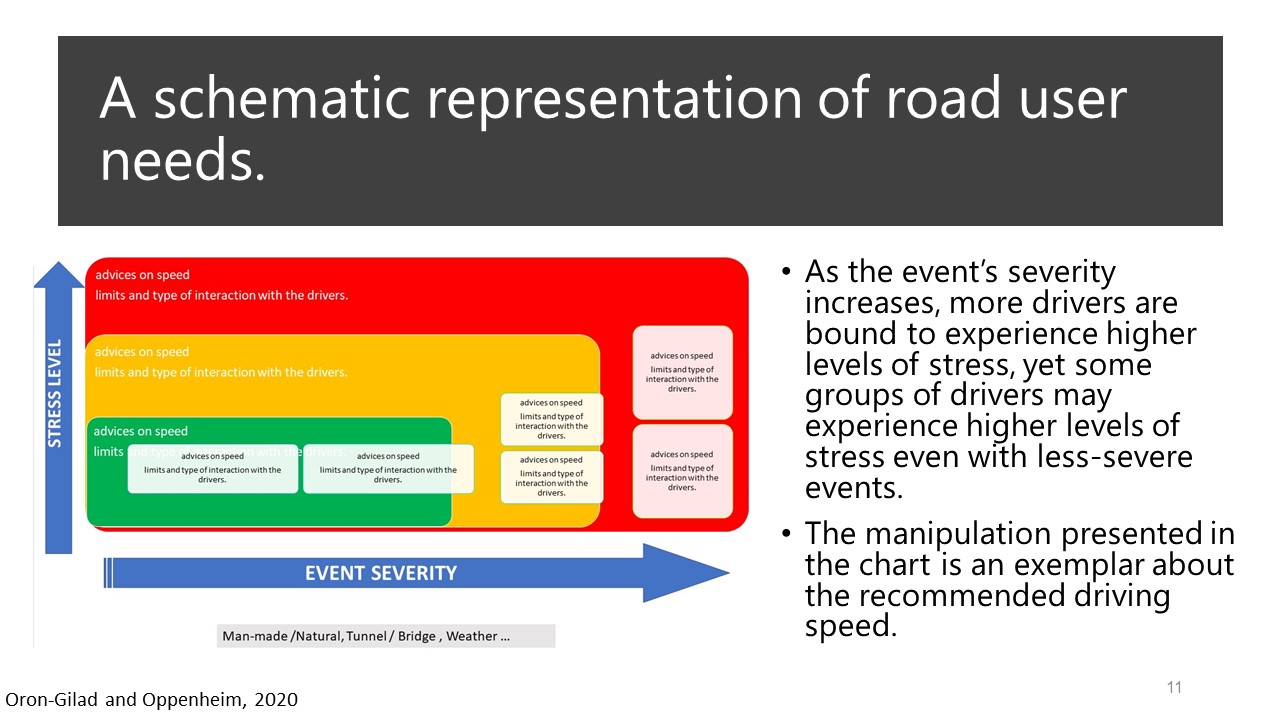
We present a theoretical module for assessing highway users’ behavior under stress. We identified that conveying information to road users during an extreme event is not sufficiently addressed in emergency handling procedures of road operators. Our work reduced the number of questions needed to map user characteristics to nine factors emerged; 1) Driving experience on bridges, 2) Driving patterns (e.g., license years, annual driven kilometers), 3) Driving experience in tunnels, 4) Risk tendency, e.g., avoidance after a recent extreme event, 5) Willingness to use dedicated applications, 6) Experience in emergencies, 7) Self-declared risk-taking tendency, 8) Perception of event severity, 9) Risk tendency and coping strategies. We then group road users by their needs and requirements when emergency events occur into three clusters: “Panic” who in case of emergency may panic. . “Anxious” who in case of emergency may panic, and “Calm” The outcomes determine the granularity of the required information for road users.
Addressing target audiences and expressing needs
- To raise awareness and possibly influence policy
- Fellowship to advance my/our research
Transportation resilience by including road user needs into resilience models
•Technology enables road operators to inform road users via media, electronic boards, or designated emergency applications.
•New methods of data collection (i.e., probe data) complement the panel of information in order to provide customized services to users and increase traffic resilience
- EU and Member State Policy-makers
- Research and Technology Organisations
- Academia/ Universities
R&D, Technology and Innovation aspects
The theoretical module and its basic application were demonstrated in the RESIST app.
This module can be applied to different road environments and cultures