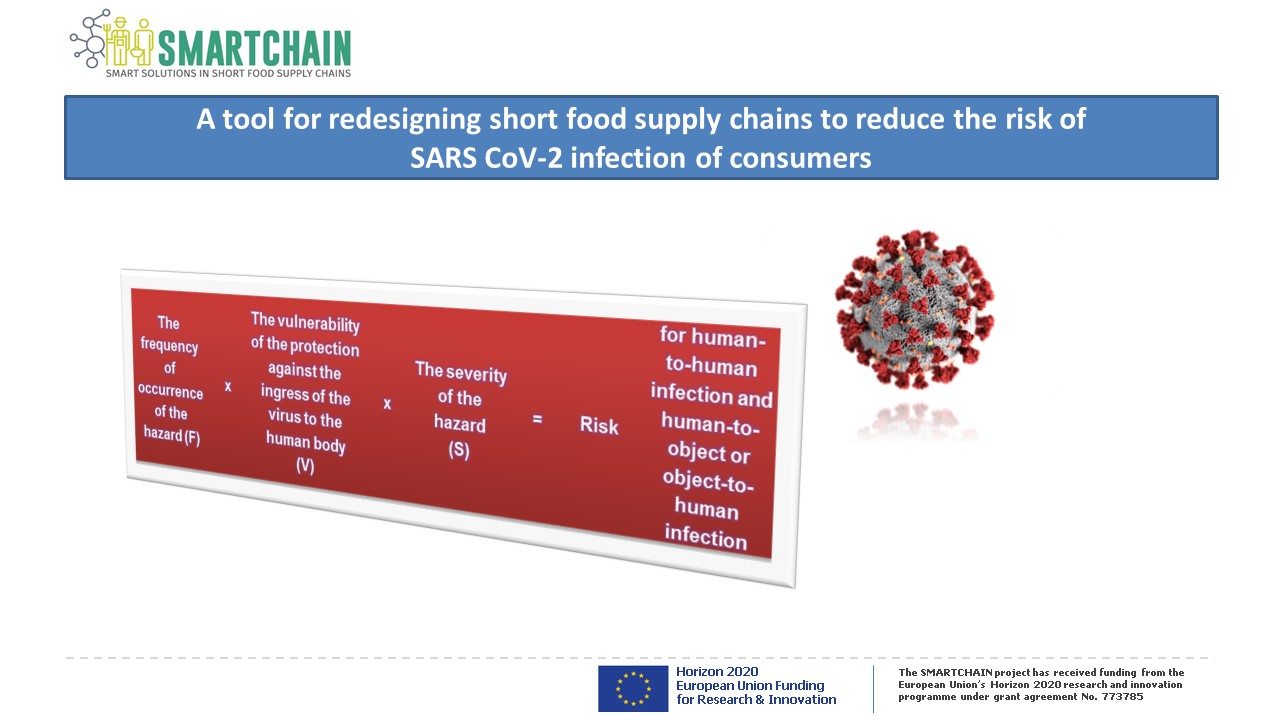
A tool was developed to assess the risk of infection of consumers during purchasing at each step of an SFSC and to identify those measures that can reduce this risk. The SFSC and conventional food chains also can be redesigned to ensure safer purchasing conditions. The microbiological risk assessment is combined with a HACCP study. The risk of SARS CoV-2 infection of consumers is calculated for each step of an SFSC as a product of the frequency of hazard occurrence, the vulnerability of the protection against the ingress of the virus to the human body, and the severity of the hazard. The risk is expressed as a score for each step. The higher the risk, the higher is the score. The steps representing a higher risk can be identified, and the risks associated with the different types of the SFSCs can also be compared. Appropriate controls can be developed and implemented at the steps, representing a higher risk. The specific SFSC can be redesigned to reduce the risk. The tool is made of the method for the risk assessment of the infection of consumers, generic models elaborated for 19 types of SFSCs, guidance to good practices, and redesigning SFSCs.
Addressing target audiences and expressing needs
- Business partners – SMEs, Entrepreneurs, Large Corporations
- Investor readiness training
- Executive Training
Short Food Supply Chains and their members, food businesses, food chain operators
- Other Actors who can help us fulfil our market potential
- Research and Technology Organisations
R&D, Technology and Innovation aspects
Testing and demonstration of the method. Promoting the application.
Developing a training course and consultancy.
Selling the guide for a small fee, training course and consultancy for a fee.
- Europe