
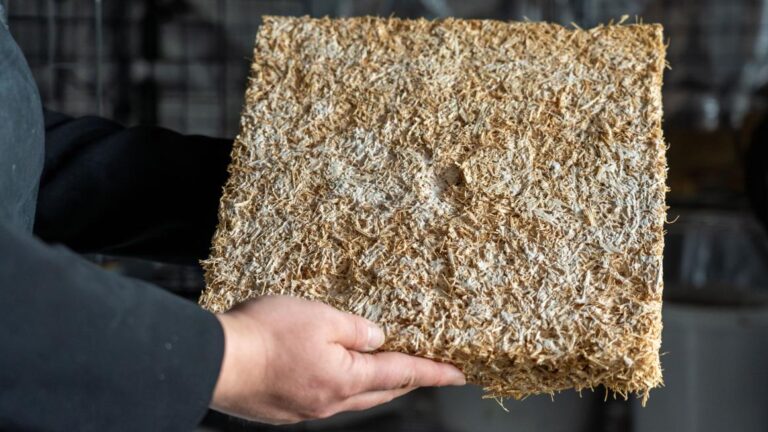
Hof – Rising energy prices and limited resources are placing major challenges on the construction industry. At the same time, natural materials are gaining importance as alternatives to fossil-based insulation in order to enable sustainable solutions for energy-efficient buildings. This is where the research project “Mycobuild” comes in, currently being carried out at the Institute for Circular Economy of Bio:Polymers (ibp) at Hof University of Applied Sciences. The aim is to develop application-ready thermal insulation materials based on fungal mycelium and to establish an industrial manufacturing process.
Conventional insulation materials are often made from synthetic or mineral-based substances that involve high energy consumption and poor environmental balance in their production. The Hof University project takes a different approach: insulation made from fungal mycelium. Project leader Prof. Dr. Robert Honke explains:
“Fungal mycelia offer numerous advantages: they are compostable, CO₂-storing, and require less energy to produce compared to conventional fossil-based insulation. In addition, they can be flexibly shaped and are industrially scalable.”
The production process and its challenges
The production of mycelium-based insulation, as tested in Hof, involves several steps. First, a substrate made from regionally available plant residues, such as dry straw, is prepared as a nutrient base for the fungi. The mycelium of a selected fungal species is then applied, which grows through the material within days in the desired form and binds it into a solid composite. Afterward, the material is dried, heated, and the fungus is inactivated.
One of the greatest challenges is enabling fungal growth under controlled conditions, as the cultures are highly sensitive to contamination. Even small amounts of foreign organisms can destroy an entire batch. This makes sterile working conditions and the choice of an optimal substrate essential. Dr. Katharina Wellmann, research associate at the ibp, explains:
“We must strike the perfect balance: the substrate must provide enough nutrients for the mycelium to grow optimally, but it must not contain too much sugar, as this would promote mold growth.”
Extensive testing
Before the material can be used as insulation, extensive testing is required. Already in its raw form, properties such as flexibility, moisture absorption, and thermal conductivity are examined to ensure the panels meet construction standards. A key advancement is the integration of a mineral coating layer by the project partner Johann Bergmann GmbH & Co. KG, which prevents moisture penetration and minimizes the risk of mold.
The coating is applied in several steps and extensively tested to ensure the material’s properties are maintained. The technology is developing rapidly, and it may soon be possible to produce fully waterproof mycelium-based insulation, eliminating mold risks entirely. Dr. Wellmann is optimistic:
“Our tests show that the mineral coating not only protects the material but also increases its strength. We are working to optimize the process so that complete waterproofing can be achieved.”
The right fungal species and their growth conditions
A key aspect of the project is the selection of suitable fungal species. Native fungi have proven particularly promising, including oyster mushrooms, honey fungus, reddish-brown stainer, and giant polypore. These fungi can grow at room temperature and do not require additional heating or cooling – a decisive advantage for the energy efficiency of production.
“The choice of the right fungal species is critical. Some grow faster, while others form more stable structures. The oyster mushroom has proven particularly robust, spreading quickly and forming dense networks,” explains Dr. Wellmann.
Good fungi, bad fungi
However, fungal cultivation also involves risks. Cultivated fungi must withstand competition from other microorganisms. If unwanted molds spread, an entire batch can become unusable within hours. Thus, selecting the right nutrient substrate plays a decisive role, as too much sugar would promote unwanted microbial growth.
Overcoming consumer skepticism
Beyond the technical challenges, consumer skepticism must also be addressed. “Many people may be wary of insulation made from fungi, fearing potential mold issues in their homes,” admits project leader Prof. Dr. Honke. This is precisely why intensive work is being done on the mineral coating. Once this technology is fully developed, the material will be completely resistant to moisture and, ideally, indistinguishable in properties from conventional insulation.
From research to practice
The medium- and long-term goal of Mycobuild is to transfer the research results into industrial application. While the Institute for Circular Economy of Bio:Polymers at Hof University of Applied Sciences leads the scientific development and optimization of the material, Johann Bergmann GmbH & Co. KG is responsible for transferring the processes into production. A decisive factor for success will be the scalability of production, as only when sufficient quantities can be manufactured at competitive costs will the material become a real alternative to existing insulation products.
Funding
The project is supported under the DATIpilot funding program of the Federal Ministry of Education and Research (BMBF). The aim of this program is to translate innovative research approaches into practice and thus strengthen Germany’s innovative capacity.
Insulation of the future?
With Mycobuild, a promising approach for sustainable construction is being researched. Mycelium-based insulation materials could herald a paradigm shift in the industry – with benefits for the environment, the economy, and consumers. By March 2026, the project aims to demonstrate industrial feasibility and make a significant contribution to eco-friendly building practices of the future.